Advertising disclosure: this review contains affiliate links. We may earn a commission at no extra cost to you. That never changes our verdict. How we fund our work
Visium Pro Review 2026: The Real Label, the AREDS2 Comparison, and the Refund Fine Print
Visium Pro is a once-a-day eye vitamin with seven disclosed micronutrients and a 351 mg proprietary blend of 14 botanicals and carotenoids, sold as a one-time purchase through BuyGoods with a 60-day guarantee. Worth trying if you want lutein, zeaxanthin, saffron, bilberry and the classic eye vitamins in a single capsule, you have never smoked, your doctor has cleared it alongside your eye drops or medications, and you will judge it within the refund window. Skip it if you need an AREDS2-strength formula, a published dose for every ingredient, or a clinically tested product.
Visium Pro is a once-a-day eye vitamin with seven disclosed micronutrients and a 351 mg proprietary blend, sold as a one-time purchase through BuyGoods with a 60-day guarantee. It is not an AREDS2 formula: its printed doses reach 8% to 45% of the trial amounts, and its lutein and zeaxanthin doses are not disclosed.
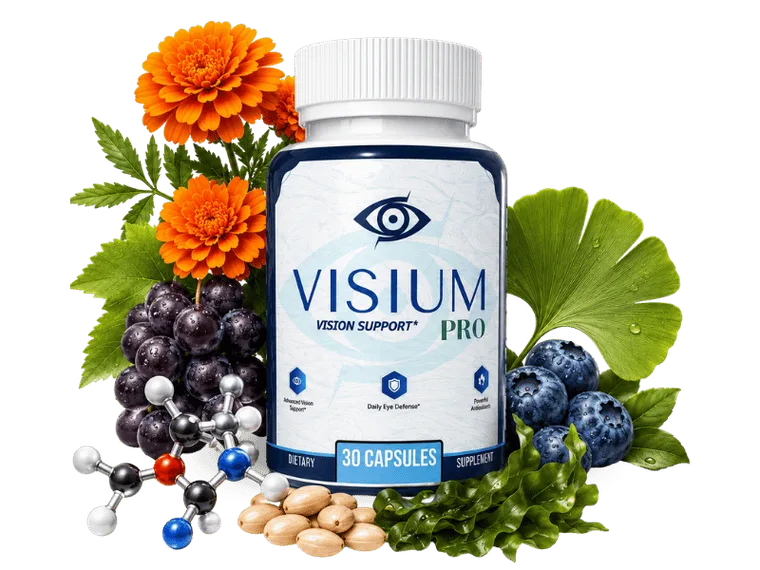
What Is Visium Pro?
Visium Pro is a dietary supplement in vegetable-capsule form, sold as a 30-capsule bottle with a serving size of one capsule and a stated use of one capsule a day. The bottle reads "Visium Pro" as two words with "Vision Support" beneath it; the website writes it as VisiumPro. It is sold only through its own website, visiumpro.com (not linked here), where the checkout is run by BuyGoods, a US online retailer that acts as the seller of record. The shipping policy names the company behind it as VisiumPro Research, with a mailing address in Orlando, Florida, and a returns depot in Aurora, Colorado. The label itself says "Distributed by Visium Force, Aurora, CO."
The brand positions it as support for the macula, for visual comfort under screen and glare exposure, and for the retinal circulation that tends to decline with age. We want to be precise about what that means from a regulatory standpoint: Visium Pro is a supplement, and supplements in the United States may only make structure/function claims. The brand's own FAQ says as much, describing VisiumPro as a dietary supplement that is not intended to diagnose or address any disease, and naming macular degeneration, glaucoma and cataracts specifically. That is the honest frame for everything below.
Who it's for
Adults who want a once-a-day capsule that combines the classic eye vitamins and minerals (A, C, E, zinc, selenium, copper) with lutein, zeaxanthin, bilberry, saffron and astaxanthin in one place, who have no diagnosed eye disease or have already discussed supplements with their ophthalmologist, and who are comfortable evaluating the product within a 60-day window. It also suits people who currently take a plain lutein softgel and want a broader formula in a single capsule.
Who it's NOT for
Anyone who smokes now or has smoked in the past, until they have talked to their doctor, because the vitamin A in this formula is beta-carotene (the section below explains why that matters). Also not for anyone already taking an AREDS2 supplement (the zinc adds up), anyone using glaucoma drops or blood thinners who has not first checked with their prescriber, pregnant or nursing women, anyone under 18, and anyone who needs to know the exact milligram amount of each ingredient before buying, because for 14 of the 21 ingredients that information is not published.
Visium Pro Ingredients: The Real Supplement Facts Panel
This is where most Visium Pro reviews go wrong. One high-ranking page lists "lutein 20 mg, zeaxanthin 4 mg, bilberry 160 mg." A copycat "official" site says the formula contains magnesium and niacin. Neither those amounts nor those two nutrients appear on the Visium Pro label. The official site does not publish the Supplement Facts panel at all; it names about ten ingredients in running text and leaves out two of the heaviest, taurine and Coleus forskohlii. The panel below is a label photo obtained from a third-party listing, because the official site does not publish it. Every ingredient the official site does name appears on it.
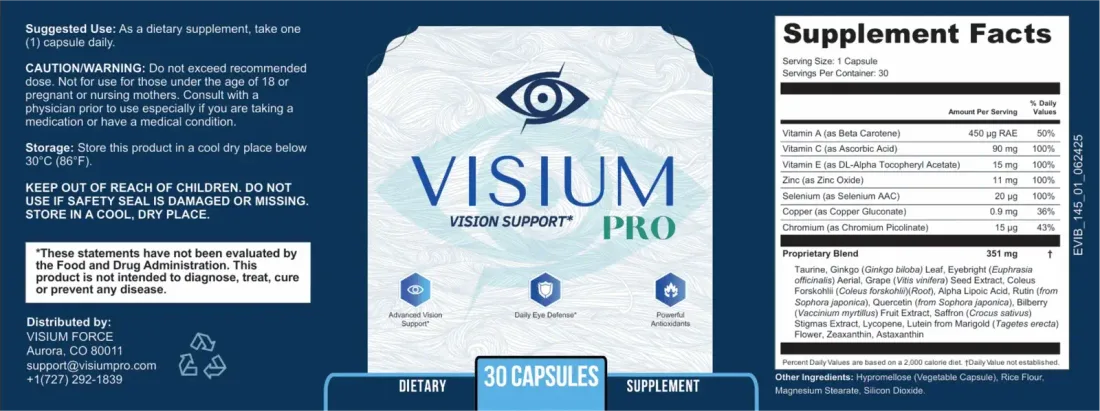
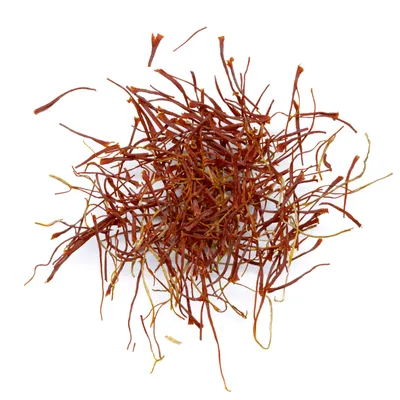
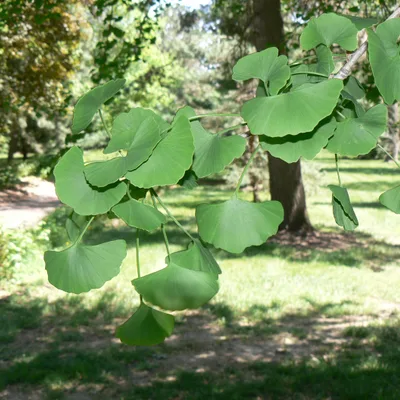
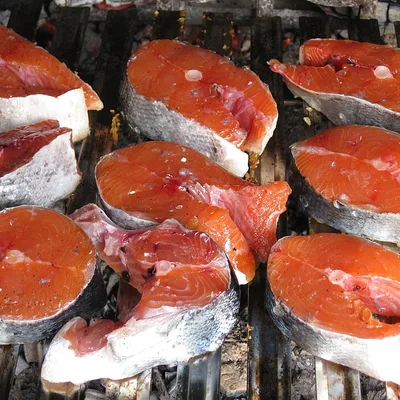
Six of the ingredients the brand highlights, pictured. The manufacturer publishes no ingredient photos, so these are reference images of the raw materials.



Three things stand out before any math. First, the vitamin E is the synthetic DL form and the zinc is zinc oxide, the least expensive forms of each, which sits awkwardly next to the "100% natural" wording on the sales page. Second, there is no omega-3, no vitamin D and no B vitamins in the formula, so if you were told to expect "eye omega-3s," they are not here (they are sold separately on a post-purchase screen, covered below). Third, one capsule holds seven micronutrients plus 351 mg of blend, and the AREDS2 formula needs two large capsules a day for its doses. That single fact explains most of what follows.
Visium Pro vs. AREDS2: Is It an AREDS2 Formula?
No. This is the most important question anyone over 50 can ask about an eye supplement, and no other Visium Pro review answers it. AREDS2 is the formula from the National Eye Institute's Age-Related Eye Disease Study 2 (published in JAMA, 2013), the one the American Academy of Ophthalmology says is often recommended for people with early to intermediate age-related macular degeneration who are at risk of developing advanced AMD. Here are the two labels side by side, using only the amounts Visium Pro actually prints.
| Nutrient | AREDS2 daily dose | Visium Pro, 1 capsule | Share of AREDS2 |
|---|---|---|---|
| Vitamin C | 500 mg | 90 mg | 18% |
| Vitamin E | 400 IU (about 180 mg) | 15 mg | about 8% |
| Zinc | 80 mg (25 mg in the low-zinc arm) | 11 mg | 14% (44% of the low-zinc arm) |
| Copper | 2 mg | 0.9 mg | 45% |
| Lutein | 10 mg | inside a 351 mg blend, 12th of 14 ingredients; dose not disclosed | unknown |
| Zeaxanthin | 2 mg | inside the blend, 13th of 14; dose not disclosed | unknown |
| Beta-carotene | removed from the formula | present: vitamin A as beta-carotene, 450 µg RAE | see next section |
The honest reading is that Visium Pro is a light eye multivitamin with a botanical blend on top, not the studied formula. On every AREDS2 nutrient whose dose is printed, it delivers between 8% and 45% of what the trial used, and the two carotenoids that define AREDS2 are hidden inside a blend with no stated amount. That does not make it useless; a multivitamin-level dose of vitamin C, zinc and selenium is a perfectly reasonable thing to take. It does mean that if your ophthalmologist told you to take AREDS2, this is not a substitute, and the AAO's own position is that the AREDS2 formula is for people with early to intermediate AMD who are at risk of progressing, not a general prevention pill for healthy eyes.
If you already take AREDS2 (PreserVision or a generic), do not add Visium Pro on your own. The zinc stacks: 11 mg here plus 80 mg in standard AREDS2 comes to 91 mg a day, more than twice the Tolerable Upper Intake Level of 40 mg a day for adults set by the NIH Office of Dietary Supplements. Even with the low-zinc AREDS2 version you would sit right at 36 mg. Long-term zinc above the upper limit can lower copper status and affect immune function. Ask the doctor who prescribed the AREDS2 before combining them.
The Beta-Carotene Line: Read This First If You Smoke or Used To
The first line of the Visium Pro panel says "Vitamin A (as Beta Carotene)." That is the single most important line on the label for a specific group of readers, and no other review mentions it. The original AREDS formula from 2001 contained 15 mg of beta-carotene. AREDS2 was designed largely to replace it with lutein and zeaxanthin, because two earlier trials in smokers (ATBC and CARET) had linked high-dose beta-carotene supplements to more lung cancer. AREDS2 excluded current smokers from its beta-carotene arms, yet still recorded more lung cancers among participants who received beta-carotene than among those who did not: 23 cases (2.0%) versus 11 (0.9%), with 91% of those cancers occurring in former smokers. The 10-year follow-up published in JAMA Ophthalmology in 2022 confirmed lutein and zeaxanthin as the appropriate replacement, and every AREDS2 product sold in the US today is beta-carotene-free for that reason.
Two things need to be said with equal weight. First, the amount here is small: 450 µg RAE corresponds to roughly 1 mg of supplemental beta-carotene under the FDA's conversion (about 5 mg under the older food conversion), against 15 mg in AREDS and 20 to 30 mg in the smoker trials. Nobody has studied a dose this low for that outcome, and this page does not claim the product causes anything. Second, AREDS2 itself concluded that lutein and zeaxanthin "could be an appropriate carotenoid substitute" precisely because of the potential increase in lung cancer among former smokers, and every AREDS2 product sold in the US today is built without beta-carotene for that reason. The safest reading is that if you smoke or ever smoked, you should show this label to your doctor before taking any beta-carotene supplement, this one included. For everyone else, beta-carotene at this level is an ordinary multivitamin ingredient.
The Label Math: What a 351 mg Blend Can and Cannot Hold
The company does not publish how much of each of the 14 blend ingredients is in a capsule. But the order of the list is not decorative. FDA regulation 21 CFR 101.36(c) requires the ingredients of a proprietary blend to be listed in descending order of weight. If the label is read the way the FDA requires blends to be ordered, a simple ceiling follows: an ingredient in position N cannot weigh more than 351 mg divided by N, because every ingredient above it weighs at least as much. That gives a maximum for each one, and the maximum is often the whole story.
| # | Ingredient | Highest possible amount | Amount used in research | Reading |
|---|---|---|---|---|
| 1 | Taurine | up to 351 mg | 500 to 3,000 mg | the largest ingredient in the blend |
| 2 | Ginkgo biloba leaf | up to 175 mg | 120 to 240 mg | could reach the studied range only if it took half the blend |
| 3 | Eyebright | up to 117 mg | no established dose | traditional use only |
| 4 | Grape seed extract | up to 87 mg | 150 to 300 mg | below the studied range |
| 5 | Coleus forskohlii root | up to 70 mg | 250 to 500 mg | below the studied range |
| 6 | Alpha-lipoic acid | up to 58 mg | 600 mg | at most about 10% of the studied dose |
| 7 | Rutin | up to 50 mg | 500 mg | below the studied range |
| 8 | Quercetin | up to 43 mg | 500 to 1,000 mg | at most about 9% of the studied dose |
| 9 | Bilberry fruit extract | up to 39 mg | 160 to 480 mg | at most about a quarter of the studied dose |
| 10 | Saffron extract | up to 35 mg | 20 mg | the studied dose fits |
| 11 | Lycopene | up to 31 mg | 10 to 30 mg | fits |
| 12 | Lutein (marigold) | up to 29 mg | 10 mg (AREDS2) | fits, but 12th of 14 means it is among the smallest |
| 13 | Zeaxanthin | up to 27 mg | 2 mg (AREDS2) | fits, undisclosed |
| 14 | Astaxanthin | up to 25 mg | 4 to 12 mg | fits, undisclosed |
These are ceilings, not measurements; we cannot see inside the capsule, and this is a judgment call based on the labeling rule. What the ceilings establish is this: four ingredients (alpha-lipoic acid, quercetin, rutin and grape seed extract) cannot be anywhere near the amounts used in studies, and bilberry tops out at about a quarter. The "bilberry 160 mg" figure published elsewhere is arithmetically impossible on this label; the ceiling is 39 mg. The "lutein 20 mg" figure is not impossible, it is simply invented: the label discloses no amount for lutein at all, and at position twelve of fourteen 20 mg would require the eleven ingredients above it to take up nearly the whole blend. Meanwhile the three ingredients with the best eye-specific evidence, lutein, zeaxanthin and astaxanthin, are the last three on the list, which by the same rule makes them the three smallest. Saffron is the exception worth noting: its 20 mg trial dose does fit in position ten, and the brand would earn real credit by simply printing the number.
Does Visium Pro Work for Vision? What the Research Says
Start with what is settled. Lutein and zeaxanthin are the two carotenoids that make up macular pigment, and AREDS2 established 10 mg and 2 mg as the doses that, together with high-dose vitamins C and E, zinc and copper, reduced progression in people who already had intermediate AMD. Visium Pro contains both, at undisclosed amounts, with the other four nutrients at 8% to 45% of the trial doses. Whether a lower-dose version does anything for a person with healthy eyes has never been tested; the AAO's advice starts with food, dark leafy greens and fatty fish like salmon, and it says plainly that supplements alone are not enough.
On the botanicals, the evidence is uneven and tied to dose. Saffron is the strongest: a randomized crossover trial in 100 people with mild to moderate AMD (Broadhead and colleagues, 2019) used 20 mg a day for three months and found small but measurable improvements in retinal function and visual acuity. That 20 mg dose fits in Visium Pro's blend, but the label does not say whether it is there. Bilberry is the weakest: a 2004 systematic review by Canter and Ernst found twelve placebo-controlled trials, and the four most recent and most rigorous of them, all randomized, were negative for night vision in adults with normal eyesight. The trials that did report an effect were the weaker ones, and the authors link the negative results partly to the more rigorous method and partly to lower doses. Bilberry extracts are typically studied at 160 mg and above, four times the ceiling this label allows. Astaxanthin has small studies on eye fatigue at 4 to 12 mg; its position at the bottom of the list makes those amounts unlikely but not impossible. Ginkgo, taurine, alpha-lipoic acid, quercetin and rutin have mechanistic or animal data for the retina, but only at amounts the ceilings above rule out. Eyebright is a traditional remedy with no clinical trials in eye health.
Visium Pro itself has no published clinical trial. The "References" link in the footer of the official site returns a page-not-found error, and the site names no formulator or medical advisor. So the honest framing is this: the formula puts genuine eye-relevant ingredients in one capsule, at amounts that are either modest (the vitamins and minerals) or unknown (the blend), and whether that adds up to a noticeable difference for you is something only your own trial, with your eye doctor's knowledge, can answer.
Glaucoma, cataracts, macular degeneration, dry eye: four different readers
Most pages treat "vision" as one word. It is not. Glaucoma is managed by lowering eye pressure with prescription drops, laser or surgery; no oral supplement has been shown to replace any of those, and stopping drops because a supplement arrived is the most common way people lose sight to glaucoma. Cataracts are a clouding of the lens that is corrected surgically; the AAO's position is that vitamins and supplements are not a cure for eye disease, and it points to a Mediterranean-style diet for cataract and glaucoma while noting that more studies are needed. Macular degeneration is the one condition where a supplement has trial evidence, and that supplement is AREDS2, at AREDS2 doses, for intermediate disease; see the comparison above. Dry eye is where omega-3s have been studied, and Visium Pro contains none. If any of those four diagnoses applies to you, the right first step is your ophthalmologist, with this label in hand.
Pros and Cons of Visium Pro
Pros
- Seven fully disclosed micronutrients at sensible multivitamin levels: vitamin C, vitamin E and zinc at 100% of the Daily Value each, and copper at 100% once the label's transposed percentages are read correctly
- Lutein, zeaxanthin, saffron, astaxanthin, lycopene and bilberry all in one capsule; saffron's 20 mg trial dose fits within the blend
- One capsule a day in a vegetable capsule, easy to keep up with
- One-time purchase; no subscription is offered at checkout today, and the seller of record is BuyGoods, a registered US retailer
- 60-day money-back guarantee with a published support email and a US returns depot
- $49 per bottle on the 6-bottle kit, the only option the order page marks free US shipping
Cons
- Not an AREDS2 formula: 8% to 45% of the trial doses on the printed nutrients, and lutein and zeaxanthin amounts undisclosed
- Vitamin A as beta-carotene, the ingredient AREDS2 removed; smokers and former smokers need a doctor's input first
- Proprietary blend: the label math caps alpha-lipoic acid, quercetin, rutin, grape seed and bilberry far below studied doses
- No clinical study of the finished formula, no named formulator, and the site's References page returns a 404
- The "Refund" link on the official site returns a 404; the real terms require returning every bottle at your cost within 60 days of the order date
- No independent customer reviews we could find; the six testimonials on the site also appear, with the same names and cities, on a different product from the same operator
Can You Take Visium Pro With Glaucoma Drops, AREDS2, or Blood Thinners?
These are the questions people actually search for, and no other review answers them beyond "ask your doctor." You should ask your doctor, and here is exactly what to ask about, based on the actual label. Do not stop or change any prescribed medication, especially eye drops, on the basis of a supplement.
- With an AREDS2 supplement: a zinc problem. 11 mg of zinc from Visium Pro plus 80 mg from standard AREDS2 is 91 mg a day, against an adult Tolerable Upper Intake Level of 40 mg. Vitamin E and copper stack as well. Taking both is not something to decide alone; the ophthalmologist who recommended the AREDS2 should make that call.
- With glaucoma drops such as latanoprost (Xalatan) or timolol (Timoptic). Two parts to this. Eye drops act locally, and the systemic interaction between a topical drop and an oral supplement is usually small; that part is reassuring. But timolol is a beta-blocker with measurable absorption into the bloodstream, and Coleus forskohlii, the fifth-largest ingredient in this blend, is the source of forskolin, a compound studied for lowering blood pressure and, in eye-drop form, for lowering eye pressure. Stacking a pressure-lowering botanical on top of a pressure-lowering prescription, for either the eye or the heart, is a specific conversation to have with your ophthalmologist and pharmacist. Keep taking your drops exactly as prescribed either way.
- With blood-pressure medication. Same ingredient, same reason: forskolin may add to the effect of antihypertensives. If you take one, check your blood pressure more often during the first weeks and tell your prescriber what you added.
- With warfarin, Eliquis, Xarelto, Plavix or daily aspirin. Ginkgo biloba is the second-largest ingredient in the blend, and the NCCIH states that ginkgo may increase bleeding risk in people taking anticoagulants such as warfarin; a 2015 analysis of a large Veterans Administration population found the same signal. Quercetin and vitamin E can also affect platelet function, although the 15 mg of vitamin E here is a modest amount. If you take any anticoagulant or antiplatelet drug, do not add this without your prescriber's sign-off and, if approved, expect closer INR monitoring.
- Pregnancy and nursing. Saffron in larger amounts has traditionally been avoided in pregnancy, and the label itself says the product is not for pregnant or nursing women. That one is simple: skip it.
- With diabetes medication. Chromium picolinate and alpha-lipoic acid can each nudge blood sugar downward. At the amounts here the effect is probably negligible, but if you use insulin or a sulfonylurea, check your glucose more often at first.
Reported side effects for this class of ingredients are generally mild: stomach upset from zinc on an empty stomach, mild headache from ginkgo, or a harmless orange tint to the skin if beta-carotene intake from all sources runs high. Stop and call your doctor if you notice unusual bruising or bleeding, a marked change in blood pressure, dizziness, or an allergic reaction. If you have a sudden change in vision, that is an emergency, not a supplement question.
Visium Pro Price: What the Official Order Page Actually Charges
These prices were read directly from the official order page on August 28, 2026. Every option is a single payment. If a website advertises a $69 single bottle, "3 bottles for $177," a $59 bottle, free e-books such as "Vision Rescue" or an "Inner Circle," or a 180-day guarantee, it is describing an older funnel or a copycat site; the order page our links open sells only the three kits below, with no bonuses.
 2 bottles · 60 days
$178
$89 per bottle · shipping added at checkout
2 bottles · 60 days
$178
$89 per bottle · shipping added at checkout
 3 bottles · 90 days
$216
$72 per bottle · shipping added at checkout
3 bottles · 90 days
$216
$72 per bottle · shipping added at checkout
 6 bottles · 180 days
$294
$49 per bottle · FREE US shipping
6 bottles · 180 days
$294
$49 per bottle · FREE US shipping
There is no single-bottle option. The order page labels the 2-bottle kit a "30 Day Supply," but two bottles of 30 capsules at one a day is 60 days, and the company's own FAQ confirms one capsule daily. The "regular prices" the order page crosses out ($358, $537 and $1,074) are not prices we could find anyone actually paying, so judge the kits by their real cost: $89, $72 or $49 a bottle. Only the 6-bottle kit is marked "FREE SHIPPING" on the order page. For the 2- and 3-bottle kits no shipping amount is printed; it appears at the BuyGoods checkout. The countdown timer and the "Bottles Remaining: 27" counter on the order page are marketing devices that reset on reload; treat them as such.
What happens after you click "Buy"
We opened the post-purchase pages the order buttons redirect to, on August 28, 2026, without completing a purchase, and there are three of them in a row. The first offers five more bottles of Visium Pro for about $147. The second is a different product, an omega-3 fish oil called "BlueOmegaOil," at about $116, under a banner warning you not to close the page or you "might be double billed" (closing the page does not bill you twice; that line is pressure, not a technical fact). The third is a sleep supplement called "CalmDreamPro," six bottles for about $147. Neither of the last two has anything to do with vision, and neither is sold anywhere else that we could find. Every one of them is optional and a single payment, and you can decline all three; a buyer who starts with the 6-bottle kit and accepts everything would pay about $704. Knowing the screens are coming is what keeps a $294 order from becoming a $704 surprise on the statement.
On your card statement the charge reads BUYGOODS, not Visium Pro. No subscription is offered at checkout today; if a "subscribe" box ever appears on the payment page, leave it unchecked. The shipping policy says an order can be canceled only within 24 hours of placing it, and billing questions go to BuyGoods at (866) 838-5063, not to the brand's support line.
60 Days or 180? The Visium Pro Guarantee, and the Refund Link That Goes Nowhere
Three well-ranked reviews say Visium Pro has a 180-day guarantee. One says 90. The order page our links open, the one the brand currently runs, shows a 60-day guarantee, and the BuyGoods checkout repeats the same 60 days. The 180-day figure belongs to copycat domains and an older set of pages. If you read "180 days" somewhere else and buy through the current page, you have 60.
Here is the part no one has reported. The footer of the official site, including the order page itself, has a link labeled "Refund." It points to a page called refund-policy.html that returns a 404 error. We checked it on the home page, the order page and the presentation page; it is broken on all three. In other words, a customer cannot read the refund policy from the page where they pay. The actual terms exist, in two places the footer does link to: the Shipping Policy (the "Returns" section) and a separate refund page that the site does not link from anywhere. Those two documents are what the company will apply, and this is the process as written there:

- Email support@visiumpro.com within 60 days, counted from the day the order was placed, not the day it arrived, and ask for the authorized return address. The refund page says not to ship anything back before you have it. The label prints one support phone number and the contact page prints a different one, so email is the channel we would rely on, and keep the reply.
- Ship every bottle back, empty, full or partially used, including any free or bonus bottles from the post-purchase screens, together with the original packing slip and a note inside the package with your order ID, full name, shipping address, email and phone number. The policy says a missing bottle results in a partial refund, so do not throw anything away.
- Return shipping is at your own cost, by USPS, and you must provide a tracking number. The depot address published in the Shipping Policy is VisiumPro, 19655 E 35th Dr., Suite 100, Aurora, CO 80011. Budget a few dollars for the package.
- The package must arrive at the depot within the 60 days. Refunds are issued within about 5 to 7 business days of receipt for credit cards (5 to 10 for debit), and the credit appears under the name BUYGOODS.
The 60-day paradox, and how to handle it. The home page says "no paperwork, you keep everything." The policies say the opposite, and the policies win. Because the clock starts on the order date and the package must arrive before it stops, shipping to you and shipping back eat up roughly two weeks; the practical window in which you can test the product and still get a refund is closer to 45 days. Meanwhile, the brand's own FAQ says results "typically develop between weeks 4 and 8" and suggests 90 to 180 days of use. Those numbers do not fit together, and no other review points it out.
Our practical read: buy the 2-bottle kit for a first trial, start the day it arrives, and make your decision around week 5 or 6. If you notice nothing by then, email support before day 45 and ship the same week. If you notice something, reorder the 6-bottle kit with full information and without the clock running. Do not buy the 6-bottle kit on the theory that "more time will tell"; the guarantee will not wait for bottle three.
Who Makes Visium Pro?
The company name in the shipping policy is VisiumPro Research, with a mailing address in Orlando, Florida (in a "Suite, Unit #" format typical of a virtual mailbox). The label names a different entity, Visium Force, in Aurora, Colorado, which is also where returns go. The seller of record at checkout is BuyGoods, a Delaware corporation. The domain visiumpro.com was registered in August 2024. The official site names no doctor, formulator or founder anywhere, has no "About us" page, and its "References" link returns a page-not-found error. That absence has one upside: unlike many products in this category, the official funnel uses no medical persona and no doctor's name, so there is nothing fabricated to unmask. Some affiliate pages attach a "clinical research pharmacist" or a "PhD fact-checker" to their reviews; on at least one of them the pharmacist's photo is a stock image. None of that comes from the brand, and we have repeated none of it.
 GMP certifiedbadge displayed by the seller; no certificate or auditor is named
 "FDA registered facility"badge displayed by the seller; registration is not approval, and the FDA does not approve dietary supplements
The official site's own wording is limited to "Manufactured in USA, Aurora, CO, GMP Certified." We could not independently verify it. No certificate of analysis, third-party lab report or lot number is published.
The same operation as NervoLyn, and the same six customers
Visium Pro is not a stand-alone company. It shares its Orlando mailing address, its Aurora returns depot, its two support phone numbers, its affiliate network, its page template and its exact kit prices ($178, $216, $294) with NervoLyn, a nerve-support supplement we reviewed separately; both domains were registered on the same day in August 2024, and their BuyGoods seller accounts sit nine apart in the same block (11283 and 11292). There is nothing wrong with one company running two products. What matters for a buyer is the testimonials: the six customers quoted on the Visium Pro site (Robert H. of Phoenix, David M. of Chicago, James K. of Houston, Walter B. of Atlanta, Thomas C. of Denver and Linda R. of Seattle) are the same six names, in the same six cities, in the same order, as the six customers quoted on the NervoLyn site, describing a different product. We show the evidence and let you draw the conclusion; ours is that these testimonials cannot be relied on.
What verifiable customers say
Nothing, because we could not find any. As of August 28, 2026, we could not access Trustpilot to confirm whether a profile for visiumpro.com exists, and no search surfaced one; there is no Better Business Bureau file, and no thread on Reddit or in the major eye-health forums. The "over 30,000 Americans," "4.98 out of 5" and "97% of customers" figures on the sales and upsell pages have no stated source, and the "11,500 verified Trustpilot reviews" and "79,200 verified reviews" quoted by two competing review sites do not link to anything. The absence of complaints is not a signal of quality; it is a signal of a product that is new and has few traceable customers. Any result you read about, including on this page, varies from person to person and is not typical.
Visium Pro on Amazon, Walmart, and the Copycat "Official" Sites
Two things confuse buyers. First, at least six look-alike domains (Visium Pro with an extra letter, a hyphen, ".us," ".org," or ".uk") present themselves as the official website; several advertise a 180-day guarantee and four bonus e-books that do not exist on the real order page, and at least one makes explicit disease claims about cataracts and macular degeneration that a supplement is not permitted to make. Second, there are "Visium Pro" listings on Amazon and Walmart from third-party sellers. The official bottle contains 30 capsules at one a day; those listings sell 60-capsule bottles, packs of two and three, a "Visium Pro Max" with a three-capsule daily dose, and one spelled "Visim Pro." Separately, "Visium Max Vision Support Drops" is a liquid from a different company altogether, and at least one review site wrongly describes it as the same product. None of those carry access to the 60-day guarantee, which applies only to orders placed through the official checkout.
Three checks before you type a card number:
- The payment page must be a BuyGoods checkout, and the charge on your statement will read BUYGOODS.
- The kits must be exactly $178, $216 and $294 for 2, 3 and 6 bottles, with a 60-day guarantee. Any other structure is a different funnel or a copycat.
- The bottle must say 30 capsules and "Vision Support." A 60-capsule bottle, a "Max" version or a liquid is a third-party product.
The buttons on this page take you to the current official order page, where that BuyGoods checkout is the only payment page.
Frequently Asked Questions About Visium Pro
Is Visium Pro a scam?
Visium Pro is a real product sold through BuyGoods, a registered US retailer, with a working support email, a returns depot in Aurora, Colorado, and a 60-day money-back guarantee that requires returning all bottles at your cost. The real risks are copycat websites, Amazon listings with different capsule counts, three post-purchase upsell screens, and reviews that invent doses, so buy only through a verified link and read the refund terms first.
Does Visium Pro work for vision?
There is no clinical study of Visium Pro. Its vitamins and minerals are at ordinary multivitamin levels, and its lutein, zeaxanthin, saffron and bilberry are inside a 351 mg blend with no disclosed amounts. Saffron's studied 20 mg dose fits in the blend; bilberry's does not. For healthy eyes the AAO recommends diet, not supplements. Results are individual and unproven; the 60-day guarantee is what makes a personal trial reasonable.
Is Visium Pro an AREDS2 formula?
No. AREDS2 provides 500 mg of vitamin C, 400 IU of vitamin E, 80 mg of zinc, 2 mg of copper, 10 mg of lutein and 2 mg of zeaxanthin. Visium Pro provides 90 mg, 15 mg, 11 mg and 0.9 mg of the first four, about 8% to 45% of the AREDS2 amounts, with lutein and zeaxanthin at undisclosed doses inside a proprietary blend. It also contains beta-carotene, which AREDS2 removed. It is not a substitute for a prescribed AREDS2 supplement.
Does Visium Pro contain beta-carotene, and does that matter if I smoke?
Yes. The vitamin A in Visium Pro is beta-carotene, 450 µg RAE per capsule. AREDS2 replaced beta-carotene with lutein and zeaxanthin after recording more lung cancers in its beta-carotene group (23 versus 11), mostly among former smokers, and for that reason every AREDS2 formula sold in the US today is made without beta-carotene. The amount here is far smaller than the trial doses, but if you smoke or ever smoked, show this label to your doctor before taking it.
Can I take Visium Pro with my glaucoma drops or with an AREDS2 supplement?
Ask your ophthalmologist first and never stop your drops. Eye drops act locally, but timolol is absorbed into the bloodstream, and Visium Pro's Coleus forskohlii has pressure-lowering effects that could add to it. With AREDS2 the issue is zinc: 11 mg plus 80 mg is 91 mg a day, more than twice the 40 mg adult upper limit, so do not combine them without the doctor who prescribed the AREDS2 agreeing.
How do I get a refund from Visium Pro, step by step?
Email support@visiumpro.com within 60 days of the order date and request the authorized return address before shipping anything. Ship every bottle, empty or full, with the packing slip and a note listing your order ID, name, address, email and phone, at your own cost by USPS with a tracking number, to the Aurora, Colorado depot. The package must arrive within the 60 days. The refund posts in about 5 to 10 days under the name BUYGOODS.
How long does Visium Pro take to work?
The company's FAQ says most people notice changes between weeks 4 and 8 and suggests 90 to 180 days of use, but the money-back guarantee closes 60 days after the order date and the return package must arrive before then. Plan to judge your results by week 5 or 6 so you can still ship a return in time. The 2-bottle kit covers that window; larger kits only make sense if you intend to continue past it.
Can I buy a single bottle of Visium Pro, or find it on Amazon?
No. The current official order page sells only 2-, 3- and 6-bottle kits at $178, $216 and $294. The "Visium Pro" listings on Amazon and Walmart come from third-party sellers, contain 60 capsules instead of the official 30 or are a different "Max" or liquid product, and carry no access to the 60-day guarantee. Buy through the official BuyGoods checkout only, and check the capsule count on the bottle image before ordering.
How We Evaluated Visium Pro
Here is exactly what we checked, how we checked it, and what we found, including what we could not find.
| What we checked | How we checked it | What we found |
|---|---|---|
| Who sells it | Followed the official order flow to the payment page; read the shipping and refund policies and the label | BuyGoods checkout; statement shows BUYGOODS; company named as VisiumPro Research, Orlando, FL, on the site and Visium Force, Aurora, CO, on the label; returns depot in Aurora, CO Verified |
| Real price today | Read the official order page on August 28, 2026 | $178 (2 bottles, shipping added at checkout and not stated on the order page); $216 (3 bottles, shipping not stated on the order page); $294 (6 bottles, free US shipping); no single bottle; no bonus e-books Shipping amount not published |
| Post-purchase offers | Opened the pages the order buttons redirect to, on August 28, 2026, without buying | Three one-time upsells: about $147 (more Visium Pro), about $116 (BlueOmegaOil, a fish oil), about $147 (CalmDreamPro, a sleep product); up to about $704 in total Verified |
| Subscription or rebilling | Checkout page and the brand's FAQ ("no auto-billing, no subscriptions") | No subscription is offered at checkout today Verified |
| Guarantee length | Order page and BuyGoods checkout of the funnel our links open, compared with copycat sites | 60 days from the order date; the 180-day and 90-day figures belong to other pages Verified: 60 days |
| Refund link on the official site | Clicked "Refund" in the footer of the home page, the order page and the presentation page | All three point to refund-policy.html, which returns a 404; the real terms are in the Shipping Policy and an unlinked refund page Verified broken |
| Refund terms, fine print | Read the full Shipping Policy and refund page | All bottles returned at buyer's cost with packing slip and USPS tracking; package must arrive within 60 days; depot at 19655 E 35th Dr., Suite 100, Aurora, CO 80011; contradicts the "you keep everything" line on the home page Verified |
| Supplement Facts panel | Searched the official site (not published there); obtained a label photo from a third-party listing and matched it to the site's ingredient text | Seven micronutrients plus a 351 mg proprietary blend of 14 ingredients; panel includes taurine and Coleus forskohlii, which the site's text omits Label source: third-party listing |
| AREDS2 comparison | Compared the printed amounts with the AREDS2 formula published in JAMA (2013) | Vitamin C 18%, vitamin E about 8%, zinc 14%, copper 45% of AREDS2; lutein and zeaxanthin undisclosed; beta-carotene present Verified |
| Blend ingredient ceilings | Applied the descending-weight rule of 21 CFR 101.36(c) to the 14-ingredient, 351 mg blend | Maximum possible amounts computed per position; alpha-lipoic acid, quercetin, rutin, grape seed and bilberry cannot reach studied doses; actual amounts unknown Judgment call |
| Clinical study of the finished formula | Searched PubMed and ClinicalTrials.gov for "Visium Pro"; opened the site's References link | None found; the References page returns a 404 Not published |
| Manufacturing claims | Read the official site's own wording and the badges displayed by the seller | "Manufactured in USA, Aurora, CO, GMP certified"; no certificate, lab report or lot number published Judgment call |
| Independent customer reviews | Trustpilot, BBB, Reddit, eye-health forums, August 28, 2026 | Trustpilot could not be accessed; no BBB file, no threads; the six site testimonials also appear on the NervoLyn site with the same names and cities Not found |
| Whether it suits your health profile | Depends on your smoking history, medications and eye diagnosis | Only your ophthalmologist or pharmacist can answer this Judgment call |
| Did our team take Visium Pro? | This is an editorial analysis of the store, policies, label and published research | No. We have not taken the product ourselves No |
Is Visium Pro Worth Trying?
Worth trying if you want lutein, zeaxanthin, saffron, bilberry and the classic eye vitamins in one once-a-day capsule, you have never smoked, your ophthalmologist or pharmacist has cleared it alongside your eye drops and medications, and you will judge it within the 60-day window. Skip it if you have been told to take AREDS2, if you smoke or used to, if you need published doses or a clinically tested formula, or if you want a single-bottle option. Either way, the refund steps are on this page.
Free US shipping on the 6-bottle kit · official BuyGoods checkout · no subscription offered at checkout today
Sources
- Visium Pro official website, order page and FAQ (visiumpro.com): product claims, pricing, guarantee wording and ingredient text; Shipping Policy with the "Returns" section at visiumpro.com/info/shipping.html; refund page at visiumpro.com/info/refund.html; the footer "Refund" link (visiumpro.com/info/refund-policy.html) and the "References" link (visiumpro.com/info/references.html), both returning 404; three post-purchase offer pages (all accessed August 28, 2026, cited as text only).
- Visium Pro Supplement Facts panel: label photo obtained from a third-party product listing, matched line by line with the ingredient text on the official site.
- Age-Related Eye Disease Study 2 (AREDS2) Research Group. Lutein + zeaxanthin and omega-3 fatty acids for age-related macular degeneration: the AREDS2 randomized clinical trial. JAMA, 2013;309(19):2005-2015 (formula doses; beta-carotene and lung cancer, 23 vs 11 cases, 91% in former smokers): pubmed.ncbi.nlm.nih.gov/23644932
- Chew EY et al. Long-term outcomes of adding lutein/zeaxanthin and omega-3 fatty acids to the AREDS supplements on age-related macular degeneration progression: AREDS2 Report 28. JAMA Ophthalmology, 2022;140(7):692-698: pubmed.ncbi.nlm.nih.gov/35653117
- American Academy of Ophthalmology. AREDS2 vitamins for AMD (who the formula is recommended for): aao.org/eye-health/diseases/vitamins-amd
- American Academy of Ophthalmology. Diet, nutrition and eye health supplements: aao.org/eye-health/glasses-contacts/diet-nutrition
- NIH Office of Dietary Supplements. Zinc: Fact Sheet for Health Professionals (Tolerable Upper Intake Level, 40 mg a day for adults): ods.od.nih.gov
- NIH Office of Dietary Supplements. Vitamin A and Carotenoids: Fact Sheet for Health Professionals (beta-carotene conversion and the smoker trials): ods.od.nih.gov
- NCCIH (NIH). Ginkgo: "Ginkgo may increase the risk of bleeding in people who are taking anticoagulant drugs, such as warfarin." nccih.nih.gov/health/ginkgo
- Stoddard GJ et al. Ginkgo and Warfarin Interaction in a Large Veterans Administration Population. AMIA Annual Symposium Proceedings, 2015: pubmed.ncbi.nlm.nih.gov/26958257
- Broadhead GK et al. Saffron therapy for the treatment of mild/moderate age-related macular degeneration: a randomised clinical trial. Graefe's Archive for Clinical and Experimental Ophthalmology, 2019;257(1):31-40: pubmed.ncbi.nlm.nih.gov/30343354
- Canter PH, Ernst E. Anthocyanosides of Vaccinium myrtillus (bilberry) for night vision: a systematic review of placebo-controlled trials. Survey of Ophthalmology, 2004;49(1):38-50: pubmed.ncbi.nlm.nih.gov/14711439
- U.S. Food and Drug Administration. 21 CFR 101.36(c), nutrition labeling of dietary supplements, proprietary blends listed in descending order of predominance by weight: ecfr.gov
- Trustpilot (could not be accessed), Better Business Bureau and Reddit searched for "Visium Pro" and "visiumpro.com" on August 28, 2026; no file or discussion found.