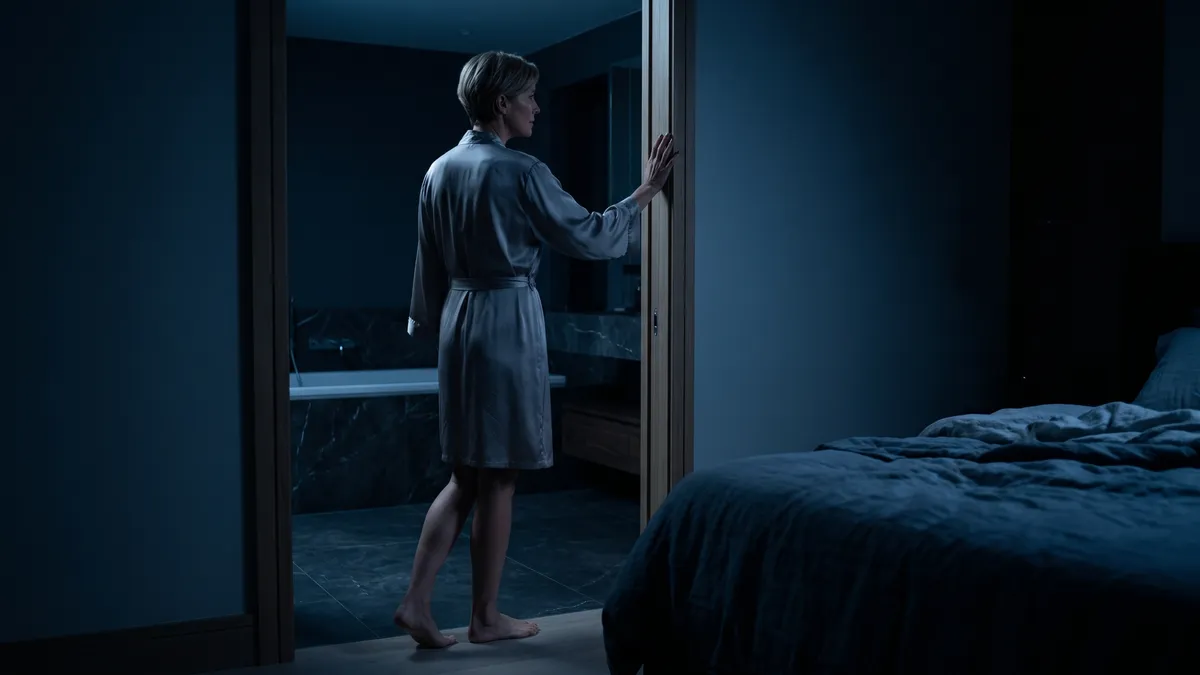
2:40 a.m. Again. You know the route in the dark: cold floor, hand on the doorframe, the light you do not turn on. Some nights the urge hits so fast you are clenching before you are upright, and a few drops arrive before you do. Then you lie there doing the math: two trips, three, work in five hours. You went before bed. So what is your bladder doing?
Between your mid-forties and your sixties, the honest answer has three parts: a hormone that is leaving, a jumpy bladder muscle, and, according to young research, a bacterial "environment" inside the bladder that may look different in women with urgency. Every number below is linked to its source. Where the science is early, we say so.
This is an affiliate link. We may earn a commission at no extra cost to you.
How many times a night is too many?
Waking twice or more to pee is where doctors start to pay attention. Cleveland Clinic defines nocturia, the medical word for night peeing, as waking at least twice, and adds that "typically, you should be able to sleep six to eight hours without having to get up to pee." The U.S. Office on Women's Health lists going "more than eight times a day or more than twice at night" as a symptom worth mentioning to a doctor.
Once a night is common. Two, three, four, every night, with the urge arriving like an alarm, is the pattern this page is about. You are not an outlier: the Sleep Foundation reports that nocturia "affects around 40% of adults ages 18 to 79," and that bothersome nocturia is more likely to start after 50. Cleveland Clinic adds: "before age 50, it's more common in females." The woman in her late forties who thinks she is too young for this is exactly who it happens to first.
Does menopause make you pee more at night?
Yes, and the main reason is estrogen. The U.S. Office on Women's Health says: "Lower levels of estrogen can affect the tissues of your vagina, vulva, bladder, and urinary tract." The listed results include "a sudden or frequent need to urinate" and "repeat urinary tract infections." Same tissue, same missing hormone, two voices.
The same agency notes that "researchers think having low levels of the hormone estrogen after menopause may weaken the urethra," and that urge incontinence "is more common in older women" and "can happen when you don't expect it, such as during sleep." Harvard Health adds: "the cells in the urinary tract that help prevent infection depend on estrogen."
Then there is sleep. The same page says "night sweats, bladder symptoms, and mood changes can disrupt your sleep," and that "menopause can also cause insomnia or sleep apnea." The trap: less estrogen makes the bladder jumpier, menopause makes sleep lighter, and a lighter sleeper notices every signal. Did the bladder wake you, or did you wake and then feel it? Many women cannot tell.
The NIDDK (NIH) estimates that "approximately half of all women experience UI" (urinary incontinence) and lists menopause among the life events that make it more likely. Common, then. Common is not the same as fine.
Why does the urge come on so suddenly at night?
Because the bladder muscle is squeezing when it should be resting, and at night nothing distracts you from it. Overactive bladder: it is not full, but it behaves as if it were, and the signal can arrive with a leak attached. At 3 a.m. it is the only thing in the room. "The muscle is overactive" is true, but it leaves the question women ask in the dark: why now, in these years? Estrogen is one answer. A second, newer one is being studied in the bladder itself.
Could the bacteria in your bladder be part of it?
Possibly. Read this part slowly. Healthy urine was taught to be sterile for most of the last century. It is not. The bladder carries its own living bacteria, the urinary microbiome (explained in plain language in our article on bladder leaks and frequent UTIs), and researchers have begun comparing it in women with and without sudden urges.
In 2014, a Loyola University Chicago team published in mBio a comparison of women with and without urgency urinary incontinence. In the authors' words, "the UUI microbiome was composed of increased Gardnerella and decreased Lactobacillus," and one protective species, Lactobacillus crispatus, was "most frequently detected in controls," the women who did not leak.
In 2020, in the American Journal of Obstetrics and Gynecology, a larger comparison found that "detection of more unique living microbes was associated with worse incontinence severity." The same authors wrote that their findings "cannot provide evidence of causation."
Where this stands, with no spin. Small studies, about fifteen years of work, methods still being refined. Nobody can tell you tonight that changing the bacteria in your bladder will keep you in bed until morning. What the research does say is that the bladder is not only a muscle, and that the environment inside it looks different in women with sudden urges. The idea is real. The proof for any product built on it is not in yet.
Put the pieces side by side. Less estrogen tends to let the protective Lactobacillus fade; women with urgency leaks carried less of it in the bladder. No trial has closed that loop. But it is the first explanation many women hear that fits the timing: the urges started when the hormone left.
What else makes you pee at night that has nothing to do with menopause?
Plenty, and some of it matters more than any bladder question. Rule these out first; several are the body asking for a different kind of help.
| Possible cause | Why it sends you to the bathroom | What tends to give it away |
|---|---|---|
| Fluids, alcohol, caffeine late in the day | Alcohol and caffeine act as diuretics. Cleveland Clinic names "drinking too many fluids before bed, especially alcohol, carbonated drinks or caffeine." | Worse after wine with dinner or an evening coffee |
| Sleep apnea | Breathing pauses change the hormone signals that control urine production. The Sleep Foundation says nocturia "occurs in up to 50% of people with obstructive sleep apnea." | Snoring, gasping, waking unrefreshed |
| Diabetes or high blood sugar | Extra sugar pulls water into the urine. Both sources list diabetes. | Thirst, peeing a lot by day too, tiredness |
| Heart failure, kidney disease, high blood pressure | Fluid pooled in the legs by day returns to the blood when you lie down; the kidneys process it at night. | Swollen ankles, breathlessness lying flat |
| Some medications | Diuretics ("water pills") and other drugs increase urine output. | Night peeing that began with a prescription |
| Menopause and the bladder itself | Lower estrogen, a jumpier bladder muscle, and possibly a shifted bacterial environment. | Sudden urges, small leaks on the way, repeat UTIs, started in your forties or fifties |
The last row is where most women start, and it should come last. Suspect apnea, blood sugar, your heart or a medication? That is a doctor's visit, not a reading assignment. Once those are cleared, the bladder row is yours.
What can you do tonight, and what should wait for a doctor?
Tonight: what you drink after 6 p.m., and how you record what happens. Everything else, including any supplement, waits for a doctor.
- Move your liquids earlier. Most of your water before late afternoon; evening alcohol, coffee, tea and fizzy drinks are the first experiment. One dry week after 6 p.m. tells you more than any article.
- Keep a two-week night diary. Bedtime, each wake-up, whether the urge woke you or you woke first, any leak. Doctors act on diaries, not on "a lot."
- Say the word menopause out loud. Over 45 and the urges are new? Ask whether low estrogen could be part of your picture. That conversation is yours and your doctor's.
- Ask about sleep, not only the bladder. Snoring or waking unrefreshed? Ask about sleep apnea.
- Be honest about the pads. A pad that moved from your purse to your pajamas means the problem was managed, not understood. Kegels help the cough-and-sneeze leak, not a bladder that fires on its own at 3 a.m.
Talk to your doctor: when night peeing is not a reading problem
⚠️ See a doctor soon, and do not wait on any article or product, if you notice:
- Blood in your urine, even once.
- Strong pain or burning when you urinate, or pain in your lower back or side.
- Fever or chills together with urinary symptoms.
- Leaks or night trips that started suddenly, or got much worse in days.
- Any loss of bowel control along with the urine leaks.
- Night peeing with snoring and daytime exhaustion (sleep apnea), unusual thirst (diabetes), swollen ankles or breathlessness lying flat (heart or kidney), or a new medication.
This article is for information only and is not medical advice. Frequent night urination can be a sign of a condition that needs treatment; a primary care doctor can order the simple tests (urine, blood sugar, kidney function), and a urologist or urogynecologist is the next step.
One honest line about supplements
One option some women look at is FemiCore, a capsule supplement whose maker describes it as support for bladder health and a balanced urinary microbiome. To be exact: it is not a treatment for nocturia, overactive bladder or menopause, we found no published study of the product, and the research above tests no supplement. Read the official page with the same skepticism you brought here, after your doctor has looked.
The honest summary: in menopause, three things shift at once. The hormone that kept the tissue thick and the bacteria friendly is leaving, the bladder muscle fires quickly, and the environment inside the bladder, the newest and least settled piece, may look different in women with sudden urges. That third piece may explain why "cut the coffee and do your Kegels" was not the whole answer for you.
Frequently asked questions
Is it normal to wake up two or three times a night to pee in menopause?
It is common, but waking twice or more is where doctors start calling it nocturia and looking for a cause. Cleveland Clinic says a healthy adult should typically sleep six to eight hours without getting up, and the U.S. Office on Women's Health lists more than two trips a night as a symptom to mention to a doctor.
Why does low estrogen make the bladder worse at night?
Estrogen keeps the tissue of the bladder, urethra and vagina thick and well supplied. The Office on Women's Health says lower estrogen can affect those tissues and lists a sudden or frequent need to urinate among the results. Menopause also lightens sleep, so a jumpier bladder is noticed more often.
Does overactive bladder at night mean I have a bladder infection?
Not necessarily, but it should be ruled out, because an infection irritates the bladder and causes the same sudden urges. Burning, fever, back pain or blood in the urine mean see a doctor promptly. If the urine test is clear and the urges continue, look at the bladder muscle, low estrogen, sleep, fluids or another condition.
Can the bacteria in the bladder cause urgency?
Nobody knows yet. Loyola University Chicago researchers found that women with urgency incontinence tended to have less Lactobacillus and more Gardnerella in the bladder, and a 2020 study found more bacterial variety went with worse leaks. The authors say these findings cannot prove cause. It is an idea under investigation.
When should I see a doctor about peeing a lot at night?
If you get up twice or more most nights, if the urges started suddenly, or if you have blood in the urine, pain, fever, unusual thirst, snoring with daytime exhaustion, swollen ankles or a new medication. A primary care doctor can check for infection, blood sugar and kidney function; a urologist or urogynecologist can look further.
Sources checked for this article
- Cleveland Clinic, "Nocturia." my.clevelandclinic.org
- Sleep Foundation, "Nocturia: Frequent Urination at Night." sleepfoundation.org
- U.S. Office on Women's Health, "Urinary incontinence." womenshealth.gov
- U.S. Office on Women's Health, "Menopause symptoms and relief." womenshealth.gov
- NIDDK (NIH), "Definition & Facts for Bladder Control Problems (Urinary Incontinence)." niddk.nih.gov
- Harvard Health Publishing, "Ask the doctor: What can I do about bladder infections?" health.harvard.edu
- Pearce MM et al., "The female urinary microbiome: a comparison of women with and without urgency urinary incontinence," mBio, 2014. PMC
- "Bladder Bacterial Diversity Differs in Continent and Incontinent Women: A Cross-Sectional Study," Am J Obstet Gynecol, 2020. PMC